The Car Knowledge Hub

Know more.
Drive confident.

HP, PCP, leasing, engines and everything in between. Make sense of the car world with bite-sized lessons and examples you can play with.

Free to explore. No application or credit check.

Two people learning about a car with an open book and a key beside a violet hatchback
01 / Start with the difference

Four routes. Different destinations.

Choose a route to see how it works.

Hire Purchase

A clear route to owning it

Often higher regular payments than a comparable PCP.

Read the full lesson →
  1. At the startAgreed deposit
  2. Along the wayRepay the balance and interest
  3. At the endOwn it after all required payments and any purchase fee

Usually no contractual mileage limit; check your agreement.

02 / Try it yourself

The money lab.

Move a slider. See where the money goes.

Learning examples only, not a quote or a recommendation. All figures are assumptions you can change.

Same car. Two repayment shapes.

HP illustration£452.02/ month
Deposit
£2,000
Amount borrowed
£18,000
Balloon
£0
Total to own
£23,697.02
Total interest
£3,697.02
PCP illustration£314.30/ month
Deposit
£2,000
Amount borrowed
£18,000
Final balloon
£8,000
Total to own
£25,086.64
Total interest
£5,086.64

PCP defers £8,000. Here it lowers each regular payment by £137.72 but adds £1,389.61 in interest if you buy the car.

How this example works

Both examples borrow the same amount with no fees and monthly payments in arrears. The monthly rate is (1 + annual rate)^(1/12) − 1. The PCP balloon is paid alongside the last of the 48 regular payments. Interest applies to outstanding borrowing including the deferred amount. Totals use unrounded calculations; lender rounding, timing, fees, APR calculation and permitted terms can differ. The balloon here is your learning input, not a vehicle valuation or a lender’s guaranteed future value.

03 / Build your knowledge

Small lessons. Useful answers.

0/12lessons marked read this visit

12 lessons to explore

01FinanceHire Purchase (HP): the road to ownershipSpread the purchase price, then own the car when the agreement is paid off.

With standard HP, you pay any agreed deposit, then repay the balance plus interest over an agreed term. The finance company owns the vehicle until all required payments, including any option-to-purchase fee, are made.

HP normally has no large balloon payment. Its monthly payments can be higher than PCP for the same car, deposit, rate and term because less debt is left until the end.

  • Check the cash price, amount borrowed, APR, term, fees and total amount payable.
  • You normally cover insurance, maintenance and running costs.
  • Do not sell or modify a financed car without the lender’s permission.
Remember this

Making monthly payments does not mean you already own the car.

02FinancePCP and the balloon paymentSmaller regular payments can leave a bigger decision at the end.

Personal Contract Purchase leaves an agreed part of the car’s price until the end: the optional final payment, often called the balloon or Guaranteed Future Value. It is not an extra deposit. Interest is normally charged on the outstanding borrowing, including the deferred amount.

At the scheduled end, you can pay the balloon and any purchase fee to keep the car, return it under the agreement’s mileage and condition rules, or discuss part-exchange. A new agreement needs a new approval; spare equity is never guaranteed.

  • A lower monthly payment does not necessarily mean a lower total cost.
  • Budget for the balloon if ownership is your aim; refinancing is not guaranteed.
  • Returning the car can bring excess-mileage, damage or other contractual charges.
Remember this

The balloon is optional only if you use another permitted end-of-contract route.

03LeasingCar leasing: pay to use, then returnUnderstand what a Personal Contract Hire agreement actually buys you.

Personal Contract Hire (PCH) is a long-term rental. You pay an initial rental and regular rentals for an agreed term and mileage. You return the car; the standard agreement has no purchase option.

Check maintenance, tyres, road tax, breakdown cover and insurance separately. Packages vary. Early exit may be expensive and needs a written quotation. Agree realistic mileage before signing, and check excess-mileage prices and fair-wear standards.

  • You do not build an ownership stake through lease rentals.
  • Servicing and condition requirements still apply.
  • FL4U’s flexible leases can have a different structure from standard PCH. The written vehicle offer confirms the term, checks, deposit, upfront charges and inclusions.
Remember this

Renting a car and borrowing to buy a car are different agreements.

04FinanceBuying outright or using a personal loanOwnership from the start, with different ways to fund it.

Buying with your own savings means no car-finance interest and no monthly credit instalments. You own the vehicle, take its resale-value risk and pay for upkeep. Keep enough money available for emergencies.

A personal loan can fund an outright purchase, but it is still debt. You usually own the car immediately and repay the loan separately. Selling the vehicle does not cancel the loan. Compare the actual rate, total repayment, fees and affordability with other options.

  • Check title and outstanding finance before paying a seller.
  • A cheaper used car can reduce borrowing but may need a larger repair budget.
  • Consider the money tied up in the car as well as the headline purchase price.
Remember this

No monthly car payment does not mean no monthly car costs.

05Money basicsAPR, interest and the monthly termLearn to look beyond the monthly headline.

APR is an annualised measure of borrowing cost including interest and relevant compulsory credit charges. It is useful for comparing credit offers, but compare the amount, term and total payable too. A flat interest rate is calculated differently and cannot be compared directly with APR.

Representative APR is not a personal promise: the FCA definition uses an expectation that at least 51% of agreements resulting from the promotion receive that rate or better. Your offered APR may differ.

A longer term spreads repayment over more months. At the same positive interest rate it usually lowers each payment but increases total interest. Check the number of regular payments, when they start and any final payment separately.

  • Total to own = deposit + all instalments + final payment + required fees, without counting fees twice.
  • Ask whether optional products are included in the borrowing.
  • Use the lender’s written quote for a real decision.
Remember this

Compare the whole agreement, not just the monthly payment.

06Money basicsDeposit, initial rental or security deposit?Three upfront payments that do different jobs.

An HP or PCP deposit contributes towards the purchase price and reduces what you borrow. It is not normally money you get back when you return the car. Any part-exchange contribution depends on value after existing finance is settled.

A lease initial rental is an advance rental, usually non-refundable. A separate security deposit may be refundable under the agreement, after permitted deductions. Ask for each amount, purpose and refund condition in writing.

  • On a 36-month 6+35 rental profile, the first payment equals six regular rentals, followed by 35 regular rentals.
  • It does not mean six months of free driving.
  • A larger initial payment can make the monthly figure look smaller. Compare total contract costs.
Remember this

The word “deposit” alone does not tell you whether a payment is refundable.

07FinanceHow can I clear HP sooner?Ask for the right figures before making an extra payment.

Ask the lender for a dated early-settlement figure. This is the amount needed to clear the agreement, with any applicable interest rebate and permitted charges. It is not simply the sum of every remaining instalment.

For a partial overpayment, ask how the lender will apply it: will it shorten the term, reduce the monthly instalment or change another amount? Ask for a revised schedule. Continue normal payments until the lender confirms the change.

  • Compare the settlement amount with remaining scheduled payments and fees.
  • Keep a buffer for essential bills and emergencies.
  • Check any early-payment conditions and obtain written confirmation that the finance is cleared.
Remember this

Overpaying can reduce interest, but the lender’s calculation and agreement determine the saving.

08Money basicsPositive and negative equityYour car’s value and your finance balance do not fall at the same speed.

Equity is the realistic current sale value minus the lender’s current settlement figure. A £15,000 valuation and £12,000 settlement gives £3,000 positive equity before any sale costs. A £10,000 valuation with the same debt gives a £2,000 shortfall: negative equity.

A valuation is an estimate, not a guaranteed sale price. Depreciation, mileage, condition and market demand all affect it. Adding a shortfall to a new agreement increases the new borrowing and may increase cost.

  • Get an up-to-date settlement figure and genuine purchase offers.
  • Positive equity is not a cash refund just for returning a PCP car.
  • At a scheduled PCP hand-back, the contract’s guaranteed-value arrangement can protect against a lower market value if its conditions are met; other charges can still apply.
Remember this

Equity is about value versus debt, not how many payments you have made.

09FinanceReturning early and payment difficultiesEarly settlement, voluntary termination and surrender are different.

For an eligible regulated HP or PCP agreement, voluntary termination can limit liability to 50% of the total amount payable, plus relevant arrears and liability for failing to take reasonable care. You can usually exercise it before paying 50% by paying the shortfall. Use the termination figure in the agreement; PCP’s balloon is included, so halfway through the months is not necessarily halfway through the money.

Voluntary surrender is different: a lender may sell the car and pursue a remaining shortfall. Standard PCH does not use the HP/PCP 50% termination rule.

  • Do not simply stop paying or leave the car at a dealer.
  • Contact the lender promptly if repayments become difficult.
  • Use free, independent debt guidance before choosing an exit route.
Remember this

Ask which route is being used and what you will still owe, in writing.

10Car basicsEngine size, power and fuel economyA 2.0-litre engine does not use two litres of fuel per journey.

Engine size describes the combined swept volume of its cylinders: 1,000 cubic centimetres (cc) is one litre. It is not the fuel-tank capacity. A larger engine can move more air and burn more fuel to make power, and often has higher fuel demand—but size alone cannot predict your bill.

Vehicle weight, gearing, aerodynamics, turbocharging, hybrid assistance, speed and driving conditions all matter. A small engine working hard in a heavy car is not always the most economical option. Compare the exact model’s official economy figures and realistic use.

  • Power (kW or bhp) describes how quickly work can be done; torque (Nm) is turning force.
  • Higher UK miles per gallon (MPG) means less fuel for the same distance.
  • Lower litres per 100 km means better economy. UK and US gallons are different.
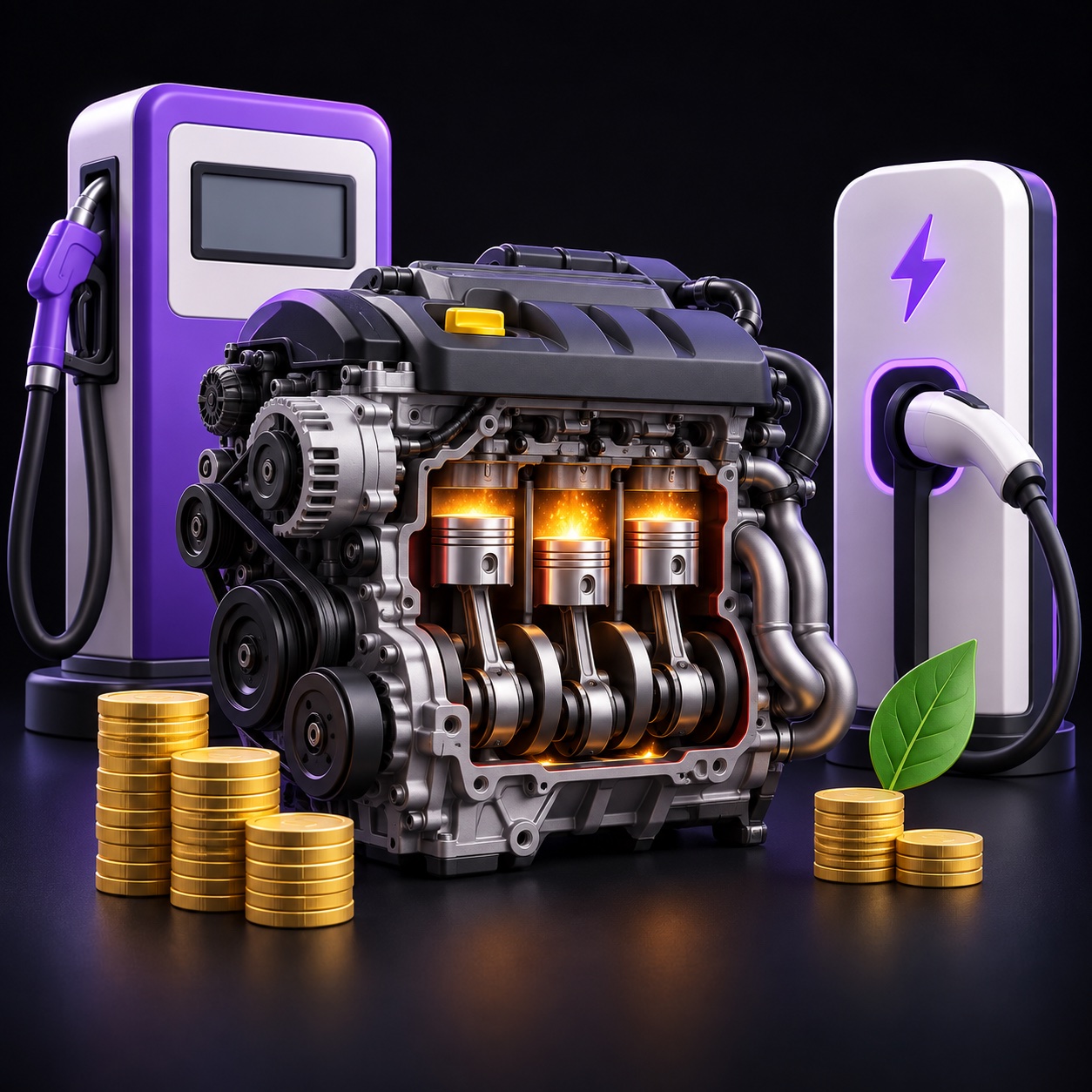
Illustrated engine, fuel pump and electric charging plug
Remember this

Compare the whole car and your journeys, not just the engine badge.

11Car basicsPetrol, diesel, hybrid or electric?Match the powertrain to the journeys you actually make.

Petrol and diesel burn fuel in an engine. A conventional hybrid combines an engine with an electric motor and a battery charged by the car. A plug-in hybrid (PHEV) also accepts external charging; regular charging matters if you want to make the most of its electric capability.

A battery electric vehicle (BEV) uses electricity with no exhaust emissions while driving. Battery capacity is measured in kWh; motor power and charging power are measured in kW. Range changes with speed, weather, heating, load and battery condition.

  • Check home or local charging access and the tariffs you would actually pay.
  • The car and charger both limit charging speed; charging is not equally fast at every battery level.
  • Compare insurance, servicing and tax as well as fuel or electricity.
Remember this

The cheapest powertrain for one driver may not be cheapest for another.

12Car basicsThe everyday car checklistA little checking can prevent a very expensive surprise.

Before buying, check the seller, VIN, vehicle details, MOT history, service records, mileage and outstanding finance. A V5C names the registered keeper; it is not proof of ownership. Inspect the car and arrange an appropriate test drive and insurance.

An MOT is a check of specified safety and environmental items at the time of the test, not a service or a guarantee of future reliability. You remain responsible for roadworthiness. Check lights, tyres, fluids and warning messages, following the manufacturer’s instructions.

  • Budget for insurance, tax, servicing, tyres, repairs, breakdown cover, parking and depreciation.
  • For most cars, minimum tyre tread is 1.6 mm across the central three-quarters and around the whole circumference; damage can make a tyre unsafe sooner.
  • Check clean-air-zone rules, permitted use and any towing or driving-abroad restrictions.
Remember this

A car that passes an MOT still needs regular care.

A violet engine, fuel pump and electric charging plug illustrate different ways to power a car
A little car know-how

Bigger engine.
Bigger fuel bill?

Sometimes—but it is not that simple. The car’s weight, technology and the way you drive all affect consumption. Explore the engine lesson, then use the fuel tool to see what MPG means for your budget.

Let’s lift the bonnet ↗
04 / Take the wheel

Ready for a quick knowledge check?

Eight questions. No sign-up. Every answer helps you learn.

0correct out of 0 answered
Question 1 / 8

When do you own a car on standard HP?

Keep this handy

Jargon, translated.

Plain-English definitions for the terms you will see.

APR
Annual Percentage Rate: an annualised borrowing-cost measure including relevant compulsory credit charges.
Balloon / optional final payment
The amount left until the end of PCP, payable if you choose to own the vehicle.
Depreciation
The reduction in a vehicle’s value over time.
Equity
Current vehicle value minus the current finance settlement amount.
Excess mileage
Miles above an agreed allowance, which can incur contractual charges.
Fair wear and tear
Deterioration expected from normal use, assessed against the agreement’s return standards.
Initial rental
An upfront lease rental, usually non-refundable, distinct from a security deposit.
Settlement figure
The lender’s dated amount to clear the agreement early.
Total amount payable
The complete amount payable under the credit agreement, including applicable deposit, interest and fees.
kW and kWh
kW measures power; kWh measures energy, such as the energy stored in a battery.
MPG
Miles per gallon. Higher MPG means travelling further on the same amount of fuel.
Soft and hard credit searches
A soft search is usually for eligibility and does not affect your credit score; a hard search is recorded as an application search. Ask which is being used.
Before you sign

Five things to be clear on.

  1. Every upfront payment and whether any of it is refundable.
  2. The regular payment, number of payments, APR where applicable and total cost.
  3. Who owns the car now, and your options at the end.
  4. Mileage, condition, servicing, insurance and early-exit terms.
  5. What happens if your circumstances change or you miss a payment.
Ask our team to explain your written offer →

Learn with confidence.

General UK education, not personalised financial advice or a finance offer. Examples are simplified. Your written agreement and applicable rights determine the actual position. Future Lease 4 U is a credit broker, not a lender; finance is subject to lender checks and terms. Standard PCH examples may differ from FL4U’s flexible lease offers.

Guidance reviewed 17 September 2026. Daily facts rotate through our source-linked learning library on the Europe/London calendar. A daily change is not a fresh review of the source. For help with payment difficulties, speak to your lender and seek free guidance from MoneyHelper or National Debtline.